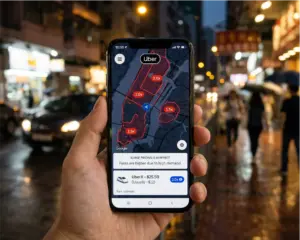
For over a decade, the idea of summoning a flying taxi through a smartphone app has lived firmly in the realm of science fiction. That changes in 2026. Uber and Joby Aviation have officially unveiled Uber Air powered by Joby, a one-tap booking experience that will let riders hail an all-electric air taxi the same way they hail an UberX today. With commercial flights expected to begin in Dubai this year and expansion planned for New York, Los Angeles, the United Kingdom, and Japan, urban air mobility is finally moving from concept to curbside — or, more accurately, to rooftop.
What Is Uber Air Powered by Joby?
Uber Air powered by Joby is a new ride option inside the Uber app that lets qualifying riders book a seat on a Joby Aviation electric vertical takeoff and landing (eVTOL) aircraft. Announced in late February 2026, the service is the culmination of a partnership between the two companies that dates back to 2019, when Uber first began exploring urban air mobility through its Elevate division.
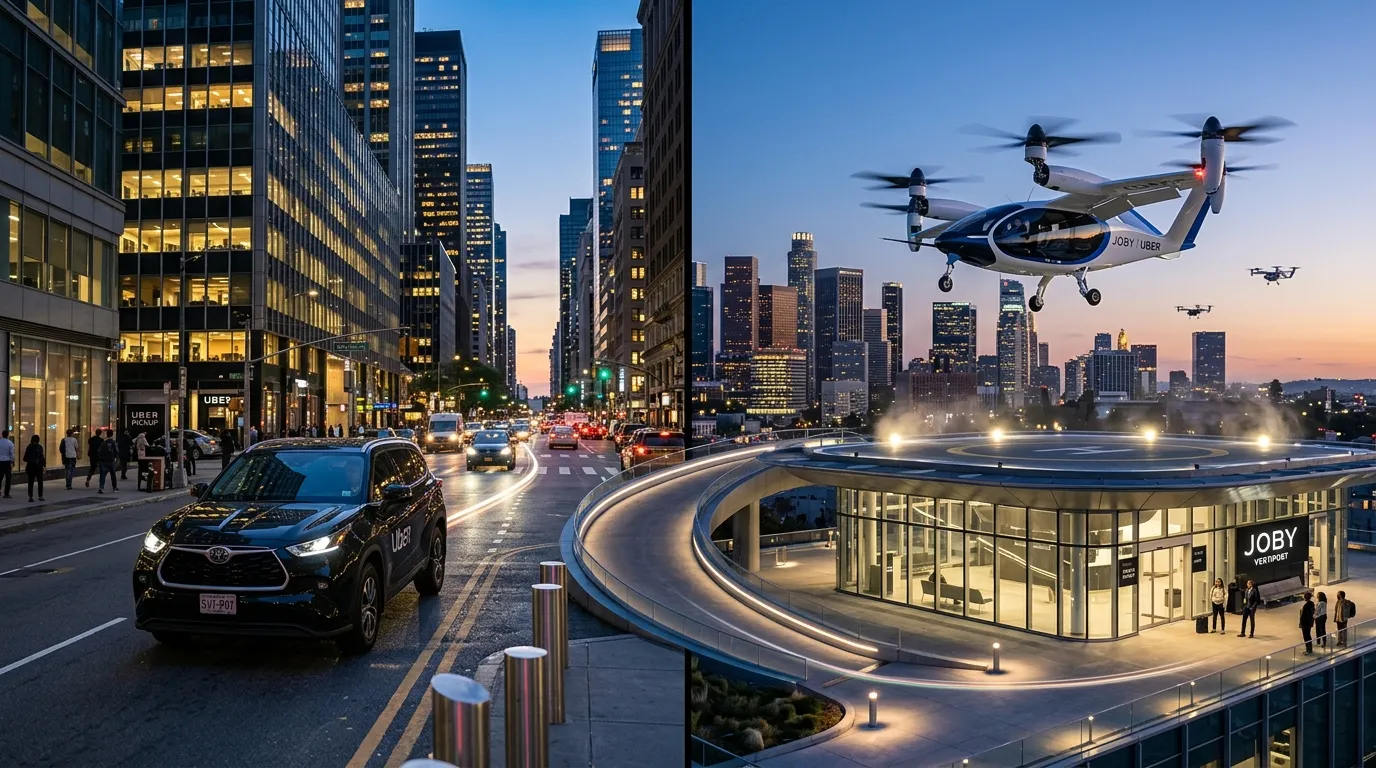
The offering is designed to feel familiar to anyone who has ever booked a ride on the Uber platform. Riders open the app, enter their destination, and if the trip qualifies, Uber Air appears alongside standard ride options. A single tap books every leg of the journey, including the Uber Black car that takes the rider to the vertiport and the one waiting at the destination.
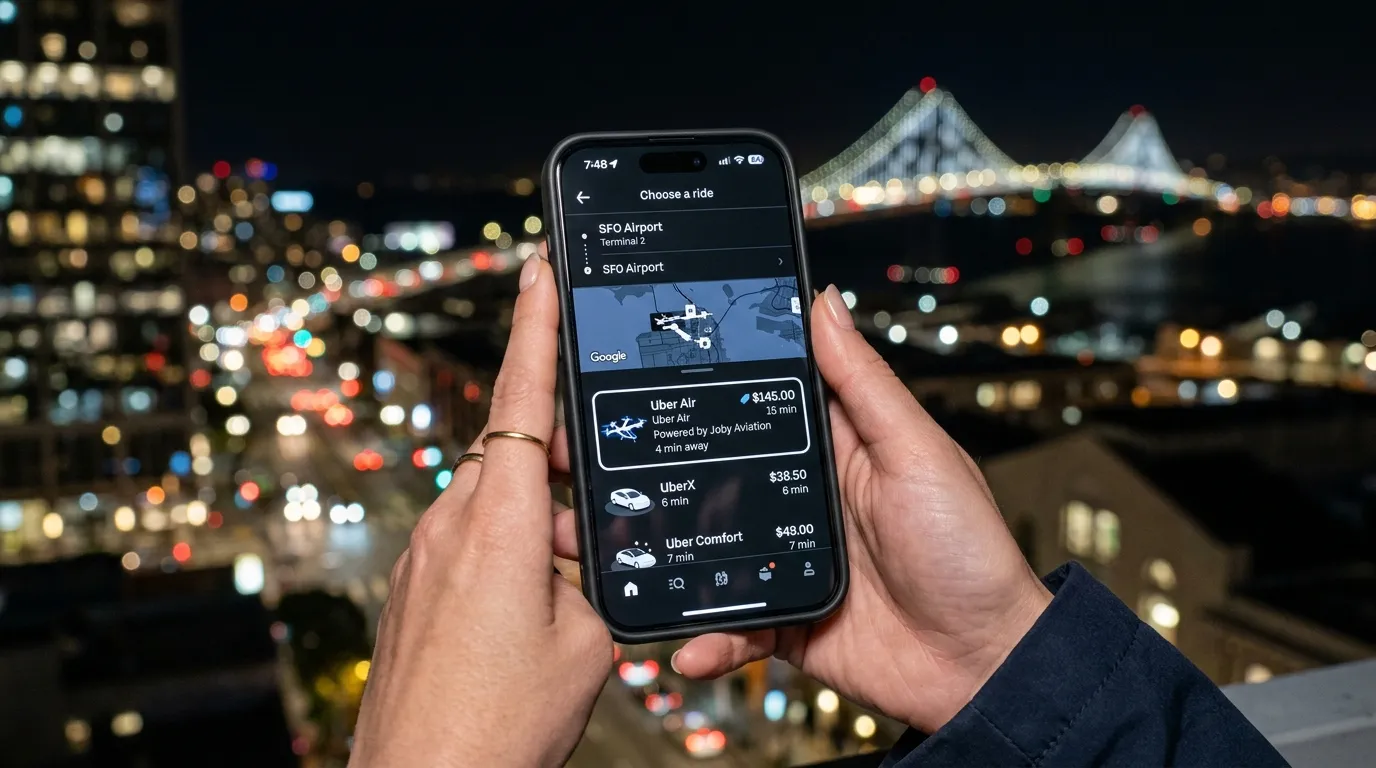
How the One-Tap Booking Works
The seamless end-to-end experience is arguably the most important part of the rollout. Urban air mobility has long faced a chicken-and-egg problem: passengers will not use vertiports without convenient ground connections, and operators cannot justify ground connections without passenger volume. By embedding the entire multi-modal journey into an app that more than 180 million people already use monthly, Uber solves that problem from day one.
Joby has also acquired Blade Air Mobility’s passenger business, which gives the combined service access to an existing network of landing points and passenger lounges, four of which are already operating in the New York City area.
Inside the Joby Aircraft
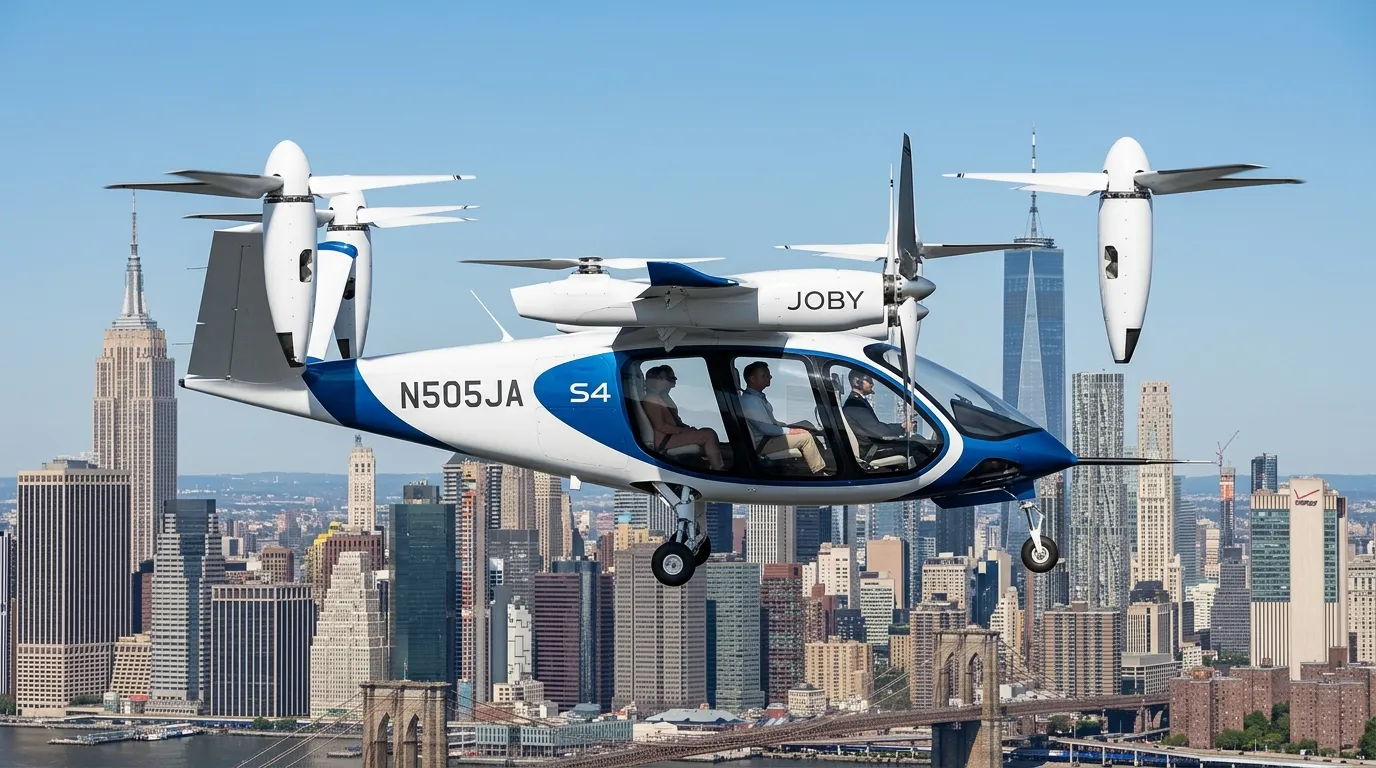
The Joby S4 is a purpose-built electric air taxi that has been in active flight testing since 2017. According to Uber’s official announcement, the aircraft is designed to carry up to four passengers plus a certified commercial pilot, with large panoramic windows giving every seat a clear view of the city below.
Speed, Range, and Safety Specs
The aircraft uses six tilting propellers to take off vertically before transitioning into forward flight. It can reach speeds of up to 200 mph and has a range of up to 100 miles on a single charge — enough to comfortably cover trips like Manhattan to JFK in roughly seven minutes, a journey that can stretch past an hour in rush-hour traffic.
Safety has been engineered in at multiple levels of redundancy. The S4 is designed with backup systems for power, flight control, and propulsion, and it is quiet enough to blend into the ambient sound of a typical city street — a significant departure from the distinctive thumping of helicopter rotors. Joby Aviation has completed more than 50,000 miles of flight testing and has entered the final stage of Federal Aviation Administration certification.
Why Dubai Is the Launch Market
Dubai’s selection as the launch city is no accident. The emirate has aggressively invested in the physical and digital infrastructure required for commercial air taxi operations, including dedicated vertiports at strategic hubs like Dubai International Airport. That infrastructure investment, paired with a regulatory environment willing to move faster than Western counterparts, gives Joby a controlled real-world testing ground before broader rollout.
The Global Expansion Roadmap
Dubai is only the beginning. Following commercial launch there, the partnership plans to expand to New York, Los Angeles, the United Kingdom, and Japan. Joby has also secured partnerships with Delta Air Lines for integrated airport transfer service in major U.S. cities, and the Federal Aviation Administration has included Joby in the White House Air Taxi program, which aims to begin U.S. passenger operations in 2026.
What This Means for Uber’s Broader Strategy
Uber Air is not a standalone product — it is one more piece in Uber’s increasingly ambitious multi-modal strategy. The company has spent the past year aggressively building out a portfolio that now includes traditional ridesharing, autonomous robotaxis through partnerships with Lucid and Nuro, and premium chauffeur service through Uber Elite. Adding air mobility closes a loop that executives have been talking about for years: moving a rider door to door, regardless of whether that journey involves a car, an autonomous vehicle, or an aircraft.
This fits into a broader pattern you can explore further in our analysis of strategic collaborations reshaping Uber’s future, where Uber has increasingly positioned itself as the platform layer across every form of urban transportation rather than the operator of any single mode.
How Uber Air Compares to Uber’s Other Innovations
The timing of Uber Air is particularly interesting when viewed alongside the robotaxi revolution also unfolding in 2026. Both products share a common thesis: that the future of transportation is not about owning individual vehicles but about aggregating demand across many modes of movement. For riders, that means one app, one account, and one seamless experience from the front door to the final destination.
What Riders Can Expect at Launch
For the first wave of passengers in Dubai, the experience will feel premium but familiar. Bookings will be available through the standard Uber app, with pricing positioned at the upper end of the ride options — comparable to Uber Black on the ground but obviously faster. Each Joby flight will be operated by a certified commercial pilot, and the aircraft’s interior has been designed with business travelers and time-sensitive trips in mind.
The Learning Curve Ahead
It would be a mistake to expect flawless execution from day one. This is a genuinely new category of consumer product, and both Uber and Joby will be learning in real time — about pricing power, about passenger comfort, about operational reliability, and about how to manage wait times at vertiports that may only serve a handful of aircraft at launch. For reference, you can see how Uber has refined similar dynamics over the years in our breakdown of Uber’s surge pricing model, which will almost certainly apply to air taxi bookings as demand spikes during peak hours.
The Road — and Sky — Ahead
Urban air mobility has promised a revolution for close to a decade, with most previous attempts ending in cancellation or quiet retreat. What makes the Uber Air launch different is the combination of proven flight testing, a willing regulatory partner in Dubai, and a distribution channel that already serves hundreds of millions of riders. Those three ingredients have never aligned at the same time before.
Whether flying taxis become an everyday commuting option or remain a premium experience for airport transfers and business trips is still an open question. What is no longer in doubt is that the category is finally real. For the first time, a rider in a major city will be able to open their phone, tap a button, and lift off — no pilot’s license, no helicopter charter broker, no science-fiction disclaimer required. The future of Uber is not just electric and autonomous. It is also, at long last, airborne.